Thursday, November 6, 2014

The Underground Army

Greetings, readers! Today is the third post of Wandering Aidan's China Series. Enjoy!

Stop Three: Xi'an! It's pronounced "Shee-ahn".

We only had one day in Xi'an, so we used it wisely. And by that, I mean we crammed in as many activities as is humanly possible.

Our first trip was to the (interestingly named) Wild Goose Pagoda. Outside the pagoda, my mom and dad took a Tai Chi class. I respectfully declined the invitation to join- Tai Chi is more or less the art of striking awkward yoga poses in slow motion- and instead opted to provide the photos below.


At one point, the instructors set a music player on the ground, which played a traditional Chinese tune. They then struck awkward yoga poses in slow motion for quite a while afterwards.

Let's take a break from that for now. There were a few other interesting demonstrations going on, like this samurai sword class. The movements were similar to Tai Chi, but revolved more around the sword.

Let's see if our instructors are done yet.

No, still going.


This was another demonstration, albeit with only one person. She had a fan act, flipping the fan open and closed with surprising grace.

There were many of these acts coming and going around the square. As we learned over the course of our travels, parks like these are much more popular in China than in the U.S., and often have a greater range of activities and ages.

Let's check on our instructors.


Our next stop was the pagoda itself. There's not much interesting about it, but there were a few interesting zodiac-themed sculptures and books at a traditional building that had been turned into a visitor center.

This is the actual pagoda.

Here's us in front of our zodiac signs.

Horse...

...Rooster...

…And Monkey.
In case you want to know your Chinese zodiac sign, here's a chart.
(photo found online)

After the pagoda, we took a drive to see the terra cotta warriors! To let the suspense build, we first stopped at a place creating and selling replicas of terra cotta warriors, among other things.

We made our own warrior replicas on our stop. Actually, all we did was stuff clay into a mold, and even then, we didn't get to keep our creations (they needed to dry for about two weeks).

Here are the finished products. They look a bit lumpy in this photo, but they actually came out quite well.

For our last major activity, we then continued on to the terra cotta warriors! There are three pits of them. Pit one is the largest, followed by pit two, then the comparatively small pit three.

Fun Fact:

The purpose of the terra cotta warriors was to provide the emperor of China with an army for the afterlife. This is why the warriors are underground- they were buried with the emperor. In fact, the emperor was narrowly persuaded away from burying thousands of actual people.

Fun Fact:

The warriors were not found in mint condition. When the warriors were discovered, almost every single one was in pieces. This is because the rebelling people of China shattered the warriors as part of their (eventually successful) attempt to take over long, long ago. Because of this, each warrior had to be painstakingly put together like a jigsaw puzzle after discovery.

Soldiers before restoration. (Pit 3)

Soldiers after restoration.


Pit 2.

This is one of the least damaged warriors ever found. The only crack was a simple fault on one of  his feet.

Some workers excavating soldiers in pit 1.

More pit 1.


A soldier taking a nap after standing up for a few thousand years,


Finally, we rounded off our adventures with a peaceful bike ride along Xi'an's town wall.


Thanks for reading!

Wednesday, November 5, 2014

Shang-hai-jinx

Greetings, blog followers! We are now on post two of Wandering Aidan’s China Series. Again, this means the miniseries is on sabbatical, but it will be back after this episode and two more.

Stop Two: Shanghai!

Shanghai was a more relaxed location, compared to the all-day tours of Yangshuo. On our first day, all we did was go to a circus show in the city; however, it was enough to make up for the lack of entertainment throughout the rest of the day.

Much of it was acrobatics- impossible to describe without photos, of which I have none- but there was a comedy act. A knife thrower boarded the stage and practiced his throwing with balloons as targets. Then he moved on to actual people. Since his assistant kept chickening out (acting, of course), volunteers were searched for in the audience. Once one was found, they placed him against the wall, and after some deliberation, they blindfolded him. On the count of three, the thrower threw the knife, hitting the board with a satisfying thunk and barely missing the man- or so he thought. Really, the knife thrower’s assistant simply jammed the knife into the wall. They repeated this a few times, eventually placing a balloon directly under the man’s groin and pretending to pop it with expert precision- again, the knife was simply jammed in, with the volunteer none the wiser.

Luckily for you, the next part of our journey yielded more photos and less description. Our second trip was through 1. A large ancient garden and 2. A maze-like marketplace.


The garden placed an emphasis on using uncut stones.


Very different things...


There is a type of dragon that only the emperor of China may use for decoration. The man who built this temple wanted to show his power- without getting killed for copyright infringement- so he simply used a different type of dragon. (On a side note, you can see the dragon's body running all the way across the wall.)


The koi fish here are often fed. As a result of this, they will swarm around people standing on the edge and open and close their humorously circular mouths. The fish at the very top and center of the picture is a good example of this.

The sign seems reasonable...

...Until you zoom out.

This is the marketplace maze. There's not much to it, but it's still kind of interesting.


Back to less adventurous matters, this is the view from the hotel room. There are two interesting things to note here:

1. There are many, many boats on the river. The river here is convenient for a crowded city like Shanghai, since materials can be hauled back and forth without disturbing anybody. Oddly, these materials seem almost always to be dirt and gravel.

2. The short buildings on the other side of the river are from the colonial era! The area is called "the Bund".

Lining the river here is a peaceful, wide-open pier. It's a pleasant place to walk in, and a welcome escape from the city.

Another oddly written sign. We saw a sign with an almost identical inscription back in the Silver Cave. "Striding" seems to be a commonly used word here on notifications.


Thanks for reading!

Bonus: Aidan’s Mandarin Lessons, Episode 2!

Today’s lesson is on having a short, meaningless conversation in Mandarin.

A fun fact before we start: Nǐ hǎo, or “hello”, is made of the words nǐ and hǎo. Don’t worry, that wasn’t the fact- that would be exceedingly obvious. Anyway, the former means “you” and the latter means “good”.

For instance, I could start a conversation with “nǐ hǎo”- “hello” in Mandarin. (Or if I’m really feeling adventurous I could try “nǐ zǎo” for “good morning”.) However, this leaves something to be desired. To get in more of a proper greeting, I can add the question word (ma) to the greeting (nǐ hǎo) to form “nǐ hǎo ma?” or “how are you?”. Despite the fact that they sound almost exactly the same, you would probably use both of them, as in “Nǐ hǎo! Nǐ hǎo ma?” or “Hello! How are you?”

There are several responses you can put to use here. You could say “Wǒ hěn hǎo” (pronounced “Wah hung hao”) for “I am very good”, or just “Wǒ hǎo” for “I am good”. Additionally, for more of a middle range, you can use “hái kě yǐ” (I’m alright) or “bù cuò” (not bad).


That’s all for now! More Mandarin will come soon!

Tuesday, November 4, 2014

Chinese Countryside (just like the movies!)


Greetings from China! Since Hong Kong is near a variety of interesting places, we’ve decided to put the location to use and take a trip. The vacation is an epic four-stop journey through a wide range of Chinese environments. I’ll describe the locations individually, one in each post.

P.S.: This also means that the mini-series is going on sabbatical. Sorry!

Stop One: Yangshuo!

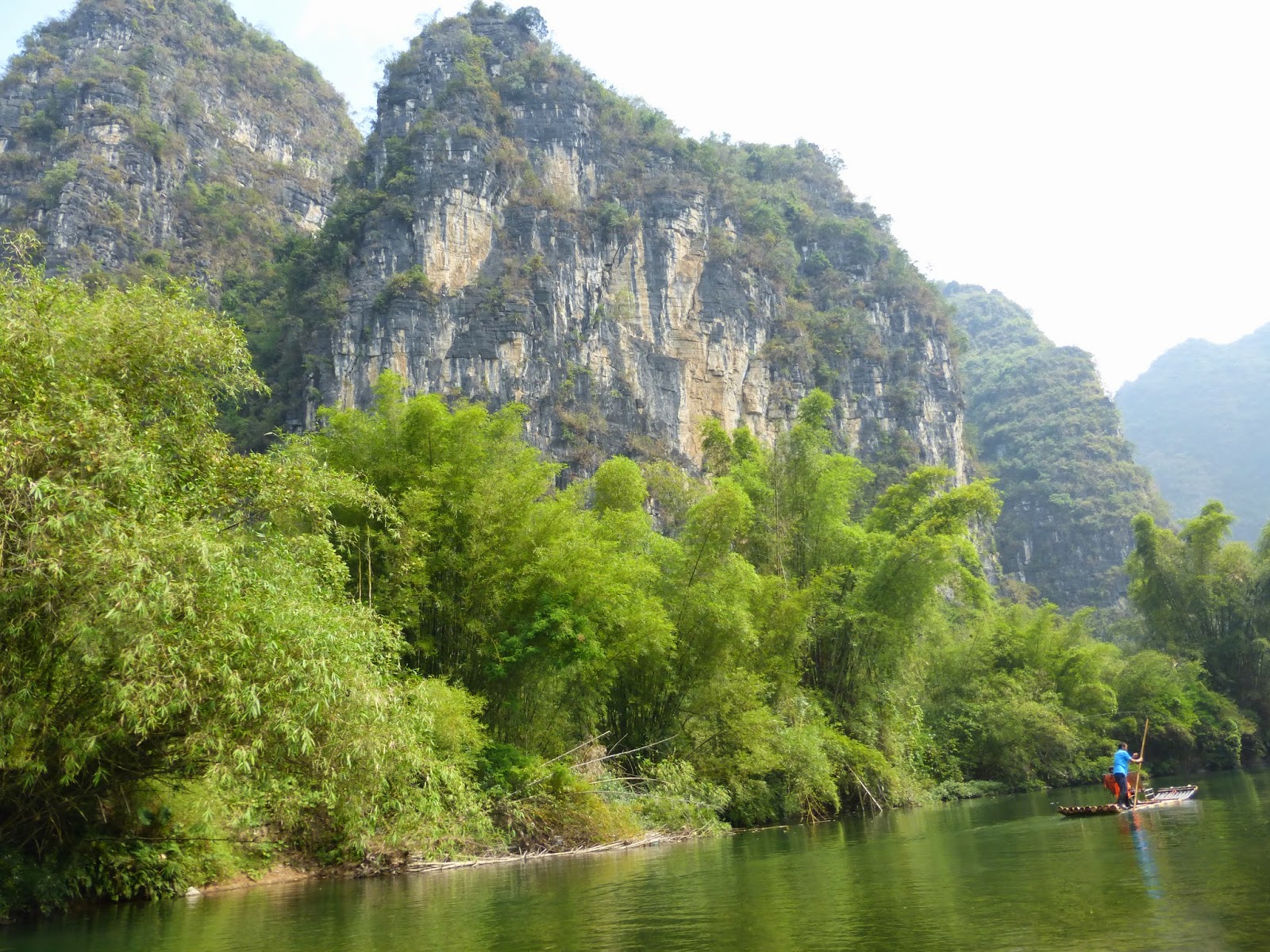
Yangshuo is a countryside town near the larger city Guilin. It is thoroughly unique for its karst (flat plains with sheer limestone towers). Karst only exists in a few places in the world, and it is at its most noticeable in Yangshuo. It is almost impossible to describe, so look at the picture below if you want the full effect.

Despite how amazing it is, this picture was actually taken by us!


On our first day, we bicycled through the beautiful countryside, swerving in and out of the karst cliffs. We eventually brought our bikes to a halt at a river. There, we were able to pay a man with a long bamboo pole to carry us serenely down the river on a bamboo raft. He pushed us along by launching off the bottom of the water with his long pole. Oh, and he hocked up about fourteen loogies.

I’ll stop there to explain something. The snort-spit, or “hocking up a loogie” where one gathers up mucus with a disgusting sound and then expels it, is a common habit in China. In fact, it’s hardly even considered rude and gross. Unfortunately for us, this means hearing a chorus of loogies wherever we go.

Still, the cruise was unique and enjoyable. A few times, we rode the raft down miniature waterfalls. That was where the bamboo style of the raft came in handy- any accumulated water on the boat seeped through the cracks instantly, letting us enjoy the rest of the peaceful drift.


Moving on: our second day was spent hiking and spelunking. Here’s the summary:

The aforementioned hike was up to the Moon Gate, a giant, half moon-shaped hole in a tall karst mountain. The gate was incredible- stalactites hung from the vast ceiling, the rock stretching seemingly endlessly above us. The hike up, however, was not as fun.

Extremely little of the “hike” was what I would call a proper hike. Instead, we had to climb hundreds of stairs up to the top. It left me emotionally scarred. I can’t bear to talk about it anymore. *sniff*

This is what a hike of a few hundred steps does to a person. About 693 steps, to be precise. But who’s counting?

The Moon Gate.


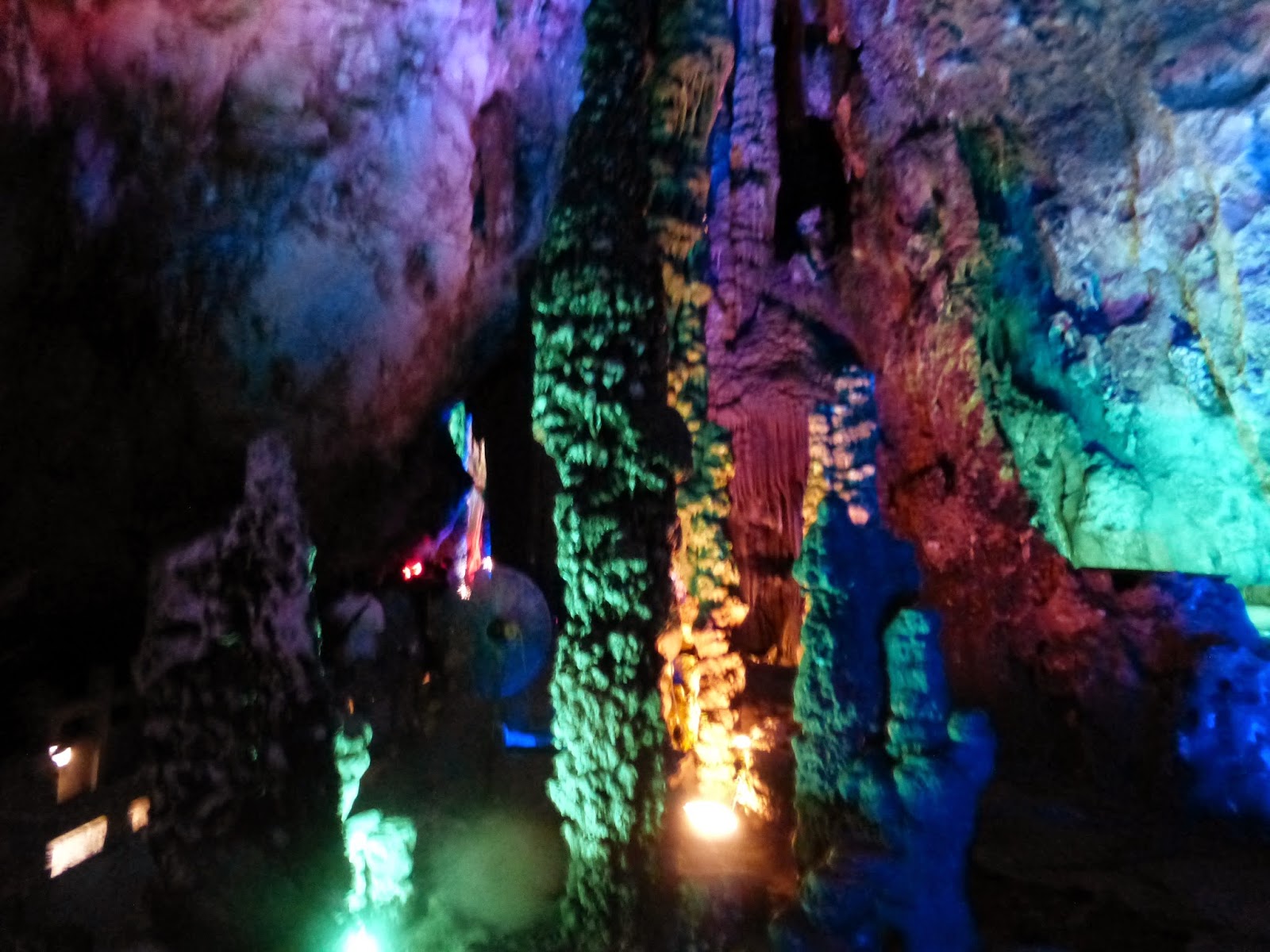
The tour of the cave was the real highlight. The cave we visited is called Silver Cave. It allegedly brings wealth to whoever enters. To us, however, it brought an amazing tour.

The cave is lit with multicolored lights, accentuating the already fantastic rock formations to the point of surreal beauty. It looks like something one might find in a video game. Just like the karst, I doubt words will do it justice, so I’ll cut to the slideshow and stop making you listen to me.


The reflection in the underground lake gives the impression of an abyss.
Oddly translated sign.


Thanks for reading!

Bonus: Aidan’s Mandarin Lessons, Episode One!

Greetings, loyal followers! If any of you care, I’ve started a new service specially for my blog readers- Mandarin lessons! If you’re interested, I’ll pass on my skills from Mandarin classes to you!

First lesson: tones. Mandarin has four tones that are crucial to pronunciation. Different tones can change the meaning of a word, so getting them right is very helpful.

Note: In pīnyīn (Mandarin written in English characters) tones can be found written above vowels.

Here are the four tones, written above the word “ma”:

Tone one: mā

This tone does not change throughout the word- the word will be all one note. It will also be a higher note that normal, almost as if you are singing. Don’t worry, it will sound more normal when grouped with other words.

Tone two: má

This is the rising tone. The pitch goes up as you say the word, like you’re asking a question.
                           
Tone three: mǎ

This one is tricky, but common. Like the symbol, the pitch of your voice should go down and then up as you say the word. It’s okay if it takes a little longer to say than the other tones.

Tone four: mà

This, like the symbol implies, is the falling tone. Words with this tone should be quick and aggressive.


Technically, there is a fifth tone, but it’s just “no tone”.


To wrap up, here are a few common phrases to get you started:

Hello: nǐ hǎo

Goodbye: zài jiàn (pronounced “zai chien”)

Sorry: Duì bù qǐ (pronounced “dway boo chee”)

Yes: Shì (prounounced “shuh”)

No: Bù


That’s all for now! Tune in next time for more Mandarin!